The planet’s southern ice cap appears to be shrinking at an alarming rate, scientists are now warning.
The rate of ice loss on and around Antarctica could be accelerating, a team of Australian scientists told reporters. If confirmed, the trend could prove devastating for iconic Antarctic species, such as penguins. More icebergs will likely appear in some Southern Hemisphere shipping lanes, as well.
In past years, the extent of Antarctic sea ice in winter appeared to return to normal levels, despite record-low sea ice cover in the summer months. Now, winter sea ice cover in Antarctica is contracting as well, the scientists said, an alarming development.
“Certainly, what we’re seeing is that winter reset…doesn’t seem to be happening anymore,” said Will Hobbs, an Australian Antarctic Program sea ice scientist.
In a new report published in the Proceedings of the National Academy of Sciences, a team of more than two dozen Antarctic and climate scientists warns that recent years of record-low sea ice cover around Antarctica are further warming the seas there. This is causing a feedback loop, likely exacerbating seasonal diminishing sea ice extents.
The trend is leading to record calving incidents, with huge glaciers breaking free from the ice shelf. As the sea ice diminishes, more land-based Antarctic ice is melting off and entering the ocean.
In a briefing with journalists, scientists with the Australian Antarctic Program said this could mean climate change forecasts could be underestimating the extent and speed of sea level rise.
“Most models are based on data produced in the last 15 to 20 years, so based on a period where we’re looking at much higher sea ice levels,” said Sue Cook, a glaciologist with the Australian Antarctic Program. “If we shift to this date where sea ice is very low but we continue using models based on the previous period, then we will definitely underestimate how quickly Antarctica will contribute to sea level rise.”
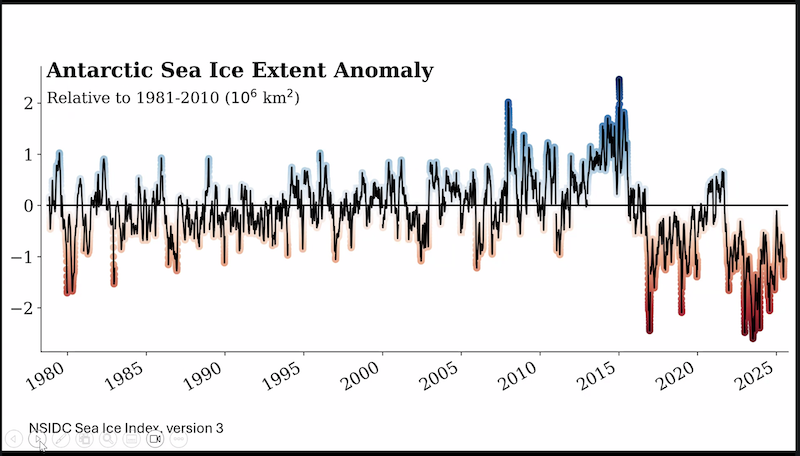
Graph: Courtesy of the Australian Antarctic Program.
The trend their seeing could lead to easier access for tourist ships to parts of Antarctica where tourists normally don’t go. Managing the aggressive rise in tourism to Antarctica is causing other problems that officials are struggling to get a handle on.
A separate study published in Nature Geoscience predicts that ongoing sea ice loss around Antarctica is leading to large-scale land-based ice calving events and larger ocean swells.
The authors explain that sea ice normally forms a protective barrier that shields land ice from rough ocean conditions. As this barrier disappears, more ice is breaking off the continent in dramatic fashion.
University of Melbourne Professor Luke Bennetts said the world should expect more of the same.
“Sea ice is retreating at an unprecedented rate all around Antarctica and our work suggests this will put further pressure on already thinned and weakened ice shelves,” he said. “This could lead to more large-scale calving events, with profound implications for the future of global sea levels.”
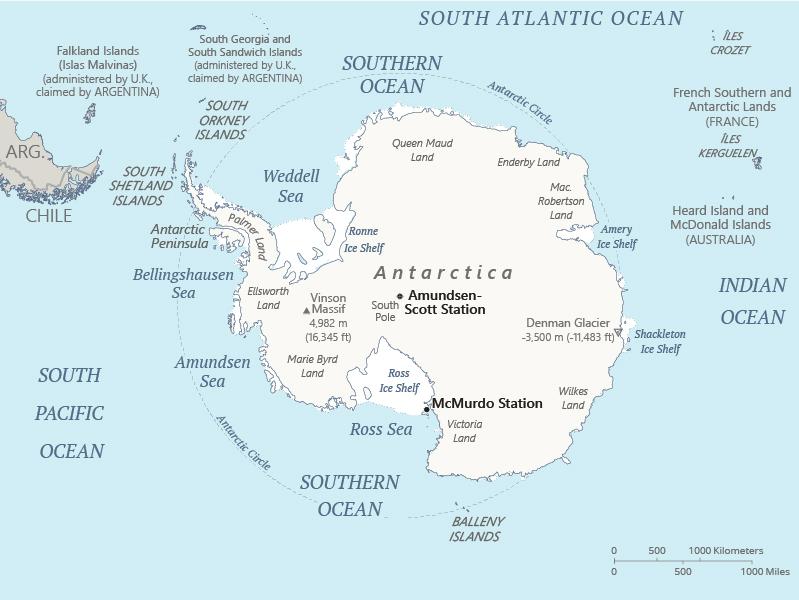
In the press briefing, officials described a recent expedition taken to a corner of Antarctica normally covered in sea ice even in summer. Surprisingly, the expedition encountered no sea ice, enabling more sampling and a broader range of research activities but alarming the scientists who participated.
“When they got down there in March this year, there was no sea ice,” said oceanographer Edward Doddridge, retelling the most recent voyage of an ice breaker near the Shackleton ice shelf. “They were free to explore and to sample and to do their science in places that people had never visited before.”
“Now in one sense, scientifically that’s fantastic,” he added. “But it does raise concerns about how quickly this system is changing because that region was meant to have quite considerable ice coverage in March, and instead it had none.”
Park Info
Location:
Antarctica
More Information: