The world lost one of its greatest champions for conservation and wildlife habitat protection last week.
Renowned primatologist and conservationist Jane Goodall passed away naturally in Los Angeles, California, while traveling for public appearances. She was 91 years old.
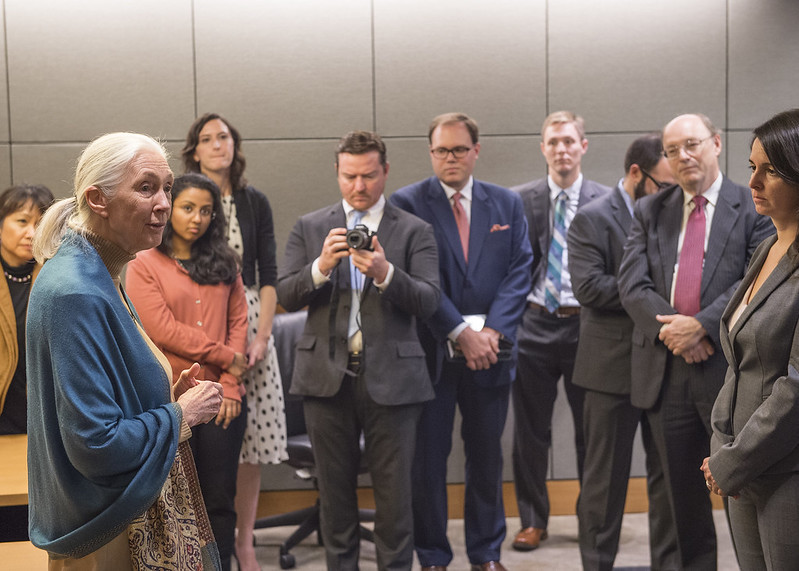
Public Parks had the honor of seeing Goodall speak at a public engagement at the United Nations some years ago. She was poised and polite, well-spoken, and engaging. Despite her many famous accomplishments, she was also remarkably approachable and affable, and she was known for her great sense of humor.
The United Nations created a special webpage to honor her legacy.
Because of Goodall’s pioneering work, we know that humans are not the only toolmakers or tool users on this planet. We also now know that humans aren’t the only species to engage in organized warfare.
And that’s just a small taste of the knowledge we’ve gained thanks to her—through her documenting hierarchies, friendships, and familial relations of the chimpanzee colonies she studied up close, we’ve all gained a much greater understanding of the animal world and a greater appreciation of what it means to be human.
Scientists and conservation leaders throughout the world continue to celebrate her life and mourn her death. Leaders at the Jane Goodall Institute, which she founded in 1977 to promote protections for wildlife, expressed their sadness and gratitude.
“Dr. Jane was known throughout the world for her 65-year study of wild chimpanzees in Gombe, Tanzania,” the Institute noted. “In the latter part of her life, she expanded her focus and became a global advocate for human rights, animal welfare, species and environmental protection, and many other crucial issues.”
Andy Lowe, Director of the Environment Institute at the University of Adelaide in Australia, called Goodall “a living icon.”
Lowe reflected on when he had the pleasure of meeting Goodall when she visited the Adelaide campus. He describes her exactly as Public Parks remembers her—pleasant, cheery, and surprisingly witty, but also insightful.
She commanded respect, and Lowe shows.
“I had the absolute honor to meet with Jane last year when she visited Adelaide on her ‘Reasons for Hope’ Tour,” Lowe shared. “After her public presentation, we held a fireside chat and got to discuss her life and influence in more detail. I have to say I was nervous, but as we talked, Jane came alive; she was bright and funny, thoughtful and reflective, insightful and inspirational.”
“In front of 2,000 people, there was absolute quiet as the audience absorbed and reflected on her life and insights,” he added.
Goodall’s work with chimpanzees led her to become a skilled anthropologist. Chimpanzees are humans’ closest living relatives in the animal kingdom.
Professor Alison Behie, an expert in biological anthropology at the Australian National University, says Goodall inspired her to set out on a different academic course after Behie had the opportunity to speak with her.
“Meeting Jane Goodall as a young university student, I was inspired to change my major and pursue a career in primate conservation,” Behie recalled. “She was so kind and supportive and really made me see I could do what she did. One of the proudest moments of my career was then introducing her to my own students when she toured Australia in 2017, allowing them to feel the same inspiration I did.”
Goodall worked tirelessly to protect the chimps she studied from poachers and other threats. For years, the chimpanzee communities of Gombe were off-limits to tourists and outsiders in general in a bid by the Tanzanian government—prompted by Goodall—to preserve the species.
Thanks in part to Goodall’s work, species protection and habitat protection are forever intertwined.
Goodall’s work boosted the case for creating and defending public parks from development and excessive human encroachment. The 1973 Endangered Species Act of the United States directs government agencies to identify and conserve critical habitat to protect species from extinction. The United Nations Convention on Biological Diversity also explicitly calls for states to create publicly protected nature preserves in defense of biodiversity.
“Jane Goodall forever changed how people think about, interact with, and care for the natural world,” Daniela Raik, interim CEO of Conservation International, said in a release. “Her legacy lives on, not just through memories and accolades, but in the sense of belief she inspired in many: that we can reverse climate change, halt biodiversity loss, and repair the natural world.”
The National Wildlife Refuge Association also paid tribute to Goodall’s legacy.
“While Dr. Goodall is remembered most for her groundbreaking work with chimpanzees, she was a tireless advocate for biodiversity and all wildlife species,” the Association said, crediting her for contributions toward protecting the US Arctic National Wildlife Refuge. “Let us all embrace Dr. Goodall’s central message of hope to inspire conservation in our communities, our wildlife refuges, and across the nation.”
She rose from modest origins to one of the world’s foremost experts on primate behavior and conservation. Dr. Goodall’s legacy will reverberate for decades and likely centuries to come.
Park Info
Park:
Gombe National Park
Location:
Tanzania
More information: https://janegoodall.org