Tech companies want to scoop up key metals from the ocean floor to bypass China’s near monopoly. Conservationists fear the next environmental crisis.
The tech industry needs critical minerals to survive and thrive.
Some hard-to-find metals are the key components to chips and batteries that make machine learning, artificial intelligence, robotics, and other fast-evolving technologies possible. China controls almost 90% of the world’s supply of many of them.
Some hold that the answer lies at the bottom of the sea in geologic formations that take millions of years to grow. Environmentalists beg to differ.
Deep-sea mining or deep seabed mining has been a contentious topic of debate for decades. The International Seabed Authority (ISA), a United Nations sub-body charged with regulating mining in the high seas, failed to finalize its long-awaited mining code at its 30th session held earlier this year, but it’s getting close to this goal.
Some in industry, like officers at the Metals Company, say they are out of patience and will no longer wait for the ISA. Troubled by this, ocean scientists are now doubling down on calls for a global moratorium on deep-sea mining in international waters, arguing that the risks to sensitive deep-sea ecosystems are far too great.
“Deep-sea mining could unleash a silent disaster in a vital, hidden part of our oceans,” warns a team of scientists at the University of Hawaii at Manoa.
Fear and loathing in Hawaii
A new study out this week, produced by UH-Manoa marine biologists, is sounding a loud alarm over deep seabed mining.
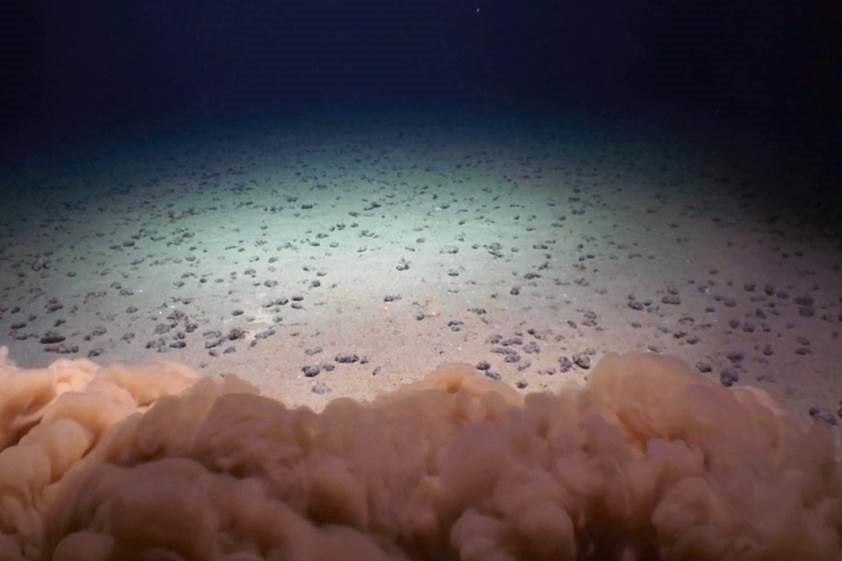
The study focused on the impact of a 2022 trial mining experiment whereby a company was given a limited license to collect polymetallic nodules from the seafloor in the Clarion-Clipperton Zone (CCZ), a huge region stretching from southeast of Hawaii to a few hundred miles off Mexico’s Pacific Coastline.
The researchers assessed the impact of the plume of silt that the mining activity generated, noting that the waste product is “as murky as the mud-filled Mississippi River,” according to lead author Michael Dowd.
Some research finds that these plumes are manageable if they are released in the right column of water, not too close to the mining activity on the bottom or the surface of the ocean, but somewhere mid-way. For instance, a recent study conducted by Australia’s Commonwealth Scientific and Industrial Research Organization (CSIRO) found that these waste plumes do cause impact but can be managed.
However, the team in Hawaii says it’s discovered that these underwater dust plumes do more than make the water murky. In a new overview of their findings, Dowd and his co-authors say these plumes change the very composition of the undersea food chain.
“Our research suggests that mining plumes don’t just create cloudy water,” said Jeffrey Drazen, a co-author and researcher at UH Manoa’s School of Ocean and Earth Science and Technology (SOEST). “They change the quality of what’s available to eat, especially for animals that can’t easily swim away.”
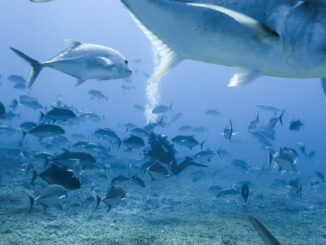
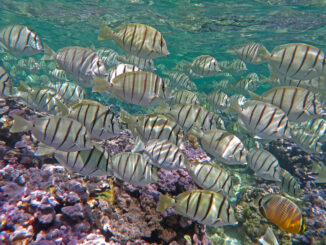
In a summary of their findings, Drazen and Dowd report that the dust plumes generated by seabed mining kill zooplankton. This, in turn, negatively impacts organisms higher up the food chain. The quality and abundance of other plankton species, krill, and fish that feed on zooplankton are diminished as a result.
It’s the first time science has made a clear connection between deep-sea mining activity and harm to oceanic food webs, though the earlier CSIRO study acknowledged that the surface impacts of mining activity are extensive and are especially damaging to immobile species like sponges and deep-sea corals.
The Hawaii research team says the damage goes even further.
“It’s like dumping empty calories into a system that’s been running on a finely tuned diet for hundreds of years,” Drazen said in his assessment.
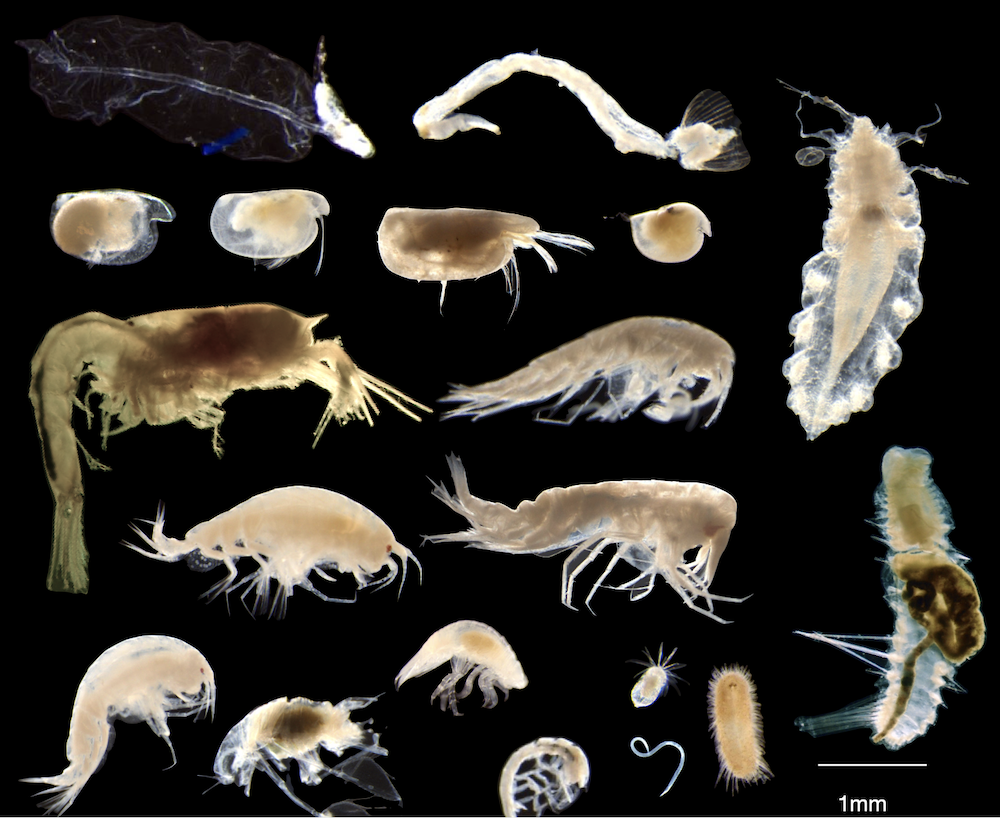
Photo: A small sampling of some species discovered during a recent exploration of the bottom of the Clarion Clipperton Zone. Gabrielle Ellis, University of Hawaii at Manoa.
Industry investigates impacts
Earlier this year, CSIRO’s Marine Biodiversity Risk & Management team leader, Piers Dunstan, hosted a call with reporters to discuss their findings.
CSIRO also took a careful look at the 2022 trial mining run in the CCZ. Dunstan acknowledged that the 2022 test was “quite substantial” but that CSIRO found that the ecological impacts of the dust plumes can be localized and managed, provided the plumes are released at the right depth in the ocean column.
If the plume is released at depths of 1,000 meters or lower, “it resulted in much more localized effects of bioaccumulation, and it was really restricted to the deep-dwelling species,” Dunstan said.
CSIRO acknowledges that it was commissioned and paid by the Metals Company to conduct the study. Still, Dunstan and his team stood by their findings, insisting that their investigation was a thoroughly conducted and neutral assessment of the potential environmental impacts of deep-sea mining.
CSIRO found that benthic lifeforms fixed to surfaces are killed off when huge machines scrape the bottom to collect polymetallic nodules. “There is complete loss underneath any footprint of any mining operation,” Dunstan said.
They also see impacts from the plume releases, though they insist that they are pretty much limited to the area immediately surrounding the mining activity. And if the plumes are released at sufficient depths, then CSIRO argues the ocean surface environment is unaffected.
“Things that occur on the seafloor, at least in the understanding that we have now, are not able to be transmitted up to the surface,” Dunstan told journalists.
This new study out of Hawaii now contradicts these findings, at least to the extent that changes in deep-sea food chains could have on larger pelagic species, including those targeted by commercial fisheries.
UH-Manoa SOEST argues that their findings imply that deep-sea mining could, in theory, negatively impact the Pacific tuna fishing industry.
“This isn’t just about mining the seafloor. It’s about reducing the food for entire communities in the deep sea,” said SOEST oceanography professor Erica Goetze.
Battle lines drawn
The debate over deep seabed mining at the International Seabed Authority and beyond pits ocean mining interests, their investors, tech company CEOS, and Pacific small island states governments against ocean scientists, conservation experts, and environmental nonprofit organizations in the United States, Canada, Australia, Japan, and beyond.
Environment America has come out strongly opposed to moves at the ISA to open up the international waters of the CCZ to seabed miners.
A new directive by the Trump Administration in the United States titled “Unleashing America’s Offshore Critical Minerals and Resources” directs federal agencies to immediately expedite licensing to companies like the Metals Company for ocean mining activities. The directive also targets the international ocean zone of the CCZ. The United States is not a member of the ISA.
Responding to Trump’s executive order, Environment America’s Kelsey Lamp, who runs the group’s Protect Our Oceans campaign, issued a statement condemning the move. The group argues that these minerals can be acquired elsewhere at far less cost, negating any need to dig up the deep ocean floor thousands of miles from any port.
“There’s so much we have yet to discover about the deepest reaches of our oceans, where wild creatures somehow eke out a living,” Lamp said. “There’s hubris to the idea that we should permanently harm these deepwater ecosystems for minerals that can be obtained elsewhere.”
For years, little was known about what impact, if any, deep-sea mining could have on the neighboring ocean environment, aside from the obvious impacts seen on the seabed. Science is gradually shedding more light on these questions.
In an earlier study also led by UH-Manoa scientists, researchers found that deep seabed mining could disturb colonies of sharks and rays. Those findings were published this year in the journal Current Biology.
What the miners are after
The International Seabed Authority declared November 1, 2025, would be the inaugural “International Day of the Deep Seabed.” The Kingston, Jamaica-based UN-agency, created with the ratification of the United Nations Convention on the Law of the Sea, is charged with ensuring ecological protection of the international seabed environment, but its chief concern is writing the rules and regulations for mineral extraction.
The ISA has been at it for 30 years and still has not finalized a mining code, though it’s closer now than it has ever been. Some member nations have forced their hand. The US threat to proceed with extraction in a process that bypasses the ISA entirely is also spurring the member states to action. For years, there has simply been no need for a code of conduct or rules for mineral extraction in the high seas because industry has shown very little interest in mining in the middle of the ocean.
That’s now changing.
Mineral companies are primarily after three deep-sea geological formations: polymetallic nodules, cobalt-rich ferromanganese crusts, and polymetallic sulphides.
The immense pressure exerted by the deep sea causes waterborne metals to attach and accrete onto hard surfaces, gradually building up layers of valuable cobalt, iron, nickel, copper, manganese, and rare earth metals in concentrations that are much higher than what is typically found on dry land. Metals can accrete to shards of bone or shark teeth to generate polymetallic nodules, which take millions of years to form but are generally no larger than a Russet potato. Cobalt-rich crusts are formed when this process occurs on rocky outposts and other hard, exposed surfaces.
Polymetallic sulphides form from deep ocean hydrothermal vents. Metals are ejected from ultra-hot seawater shooting out of these vents and accrete at the surfaces in the immediate surroundings. Gold, silver, zinc, and other valuable metals can be found at these formations.
Miners are interested in extracting the nodules first, as the technology is easier—they can simply be picked up and pumped to the surface. Exploiting sulphides and crusts would involve scraping off parts of the seafloor.
Industry’s take
The Metals Company (TMC) says these valuable metals will be extracted from the CCZ for the manufacture of electric vehicles and renewable energy technologies. Cobalt is a critical ingredient in some electric vehicle batteries.
TMC is partnering with the government of Tonga to launch commercial nodule extraction in the CCZ. Proponents of deep-sea mining say the process is more ecologically friendly than surface mining.
“While there may be technically enough metal-bearing deposits on land to meet future demand, those resources can only be extracted at increasingly high economic, social, and environmental cost,” the company says on its website. “We believe that polymetallic nodules could contribute to supplying metal resources and alleviate some of the pressures on fragile terrestrial ecosystems.”
TMC points to the environmental devastation wrought by mining in South Africa, Indonesia, the Philippines, and the Democratic Republic of Congo to drive its point across.
Opponents argue that we can supply the world’s clean energy revolution through recycling used electric vehicle batteries and other waste management schemes. TMC believes even a well-organized global recycling effort wouldn’t be nearly enough to meet growing demand for these key ingredients.
As proof, the company points to a report by the International Energy Agency that concludes only about 10% of the world’s demand for these metals could be met with recycling alone.
And though TMC acknowledges that deep seabed mining will cause environmental damage, the company argues that this will be nothing in comparison to climate change, “the biggest threat to the oceans.”
As if on cue, a new study out of Australia predicts that global warming could decimate much or most of the Great Barrier Reef by 2100, just 75 years away.
More study, or more mining?
TMC argues that studies like the one it commissioned with CSIRO show that there is a great deal known about the environmental impacts of these deep-seabed mining activities. This knowledge should empower mining companies to introduce mitigation efforts to minimize the impacts.
The UH-Manoa scientists, however, argue that there is still too much that is unknown about the broader impacts of deep-sea mining.
Their findings and other new warnings issued in the academic literature will likely spur more calls for further study and a moratorium on mining to give space and time for more research and investigations.
“Deep-sea mining has not yet begun at commercial scale, so this is our chance to make informed decisions,” said Brian Popp, co-author of the new UH-Manoa study and a professor of biogeochemistry at SOEST.
“If we don’t understand what’s at stake in the midwater, we risk harming ecosystems we’re only just beginning to study.”