Art is as old as human civilization. It predates the written word. And the world’s protected areas are home to some of the earliest surviving pieces of prehistoric art.
Last year, scientists unveiled the world’s oldest known cave painting, discovered at a special reserve on the island of Sulawesi in Indonesia. At least 50,000 years old, it shows signs of spiritualism in the painter’s retelling of a hunting adventure. It was painted in this cave long before the most recent Ice Age.
Now, archaeologists from Germany, the United Kingdom, Australia, and Saudi Arabia have reported the discovery of ancient images carved into stone walls at a site in the Arabian Peninsula.
They say these ancient artistic images are proof that humans thrived in the Arabian Desert in great numbers up to 13,000 years ago, upending earlier conclusions.
What’s more, the research team reporting its findings in the journal Nature Communications says these ancient rock carvings had a utilitarian purpose: they served as “road signs” pointing travelers to sources of water while relaying other information.
“The rock art marks water sources and movement routes, possibly signifying territorial rights and intergenerational memory,” explained co-author Ceri Shipton, a researcher with University College London’s Institute of Archaeology, in a summary.
Ancient roadsigns to water oases
The ancient pictographs are in Saudi Arabia, adjacent to the protected Nefud Desert and the King Salman bin Abdulaziz Royal Reserve. Two sites are discussed in the paper: Jebel Arnaan and Jebel Misma.
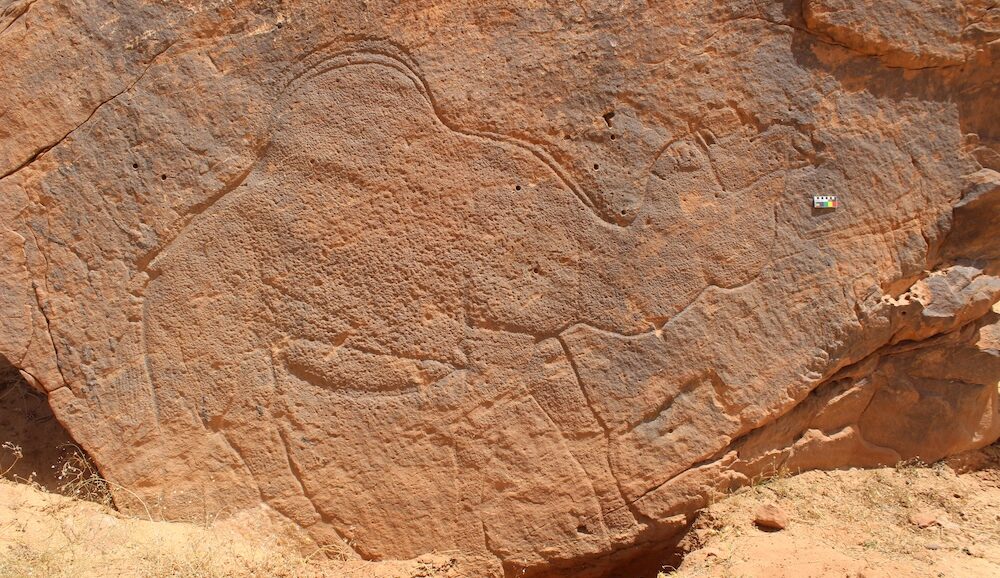
Photographs of the rock carvings shared by the scientists show haunting impressions left on the stone surfaces, some faded over time, but others are clearly visible.
One image is unmistakable: a carved impression of a camel. The team said this carving at the Jebel Misma site is large, carved to accurately depict the size of a living camel.
Other animals known to have inhabited this part of the world are also depicted in these carvings. It’s unmistakably art and a form of communication, pointing to a sophisticated society thriving in the region despite the sites’ antiquity and aridity.
“This unique form of symbolic expression belongs to a distinct cultural identity adapted to life in a challenging, arid environment,” said Dr Faisal Al-Jibreen of the Heritage Commission, part of the Saudi Ministry of Culture.
Art and communication
Per the new research paper, the Arabian Peninsula is believed to have been extremely parched during the period lying between the post-Ice Age period known as the Last Glacial Maximum and approximately 10,000 years ago. Being drier than even in our modern times, archaeologists have long believed that humans mostly abandoned the region during this time.
The discovery of these rock engravings, carved between 13,000 and 11,000 years ago, now throws those past assumptions into doubt. The research team claims their findings are unequivocal.
“During the Pleistocene-Holocene transition, human populations exploited a network of seasonal water bodies—marking locations and access routes with monumental rock engravings of camels, ibex, wild equids, gazelles, and aurochs,” they wrote.
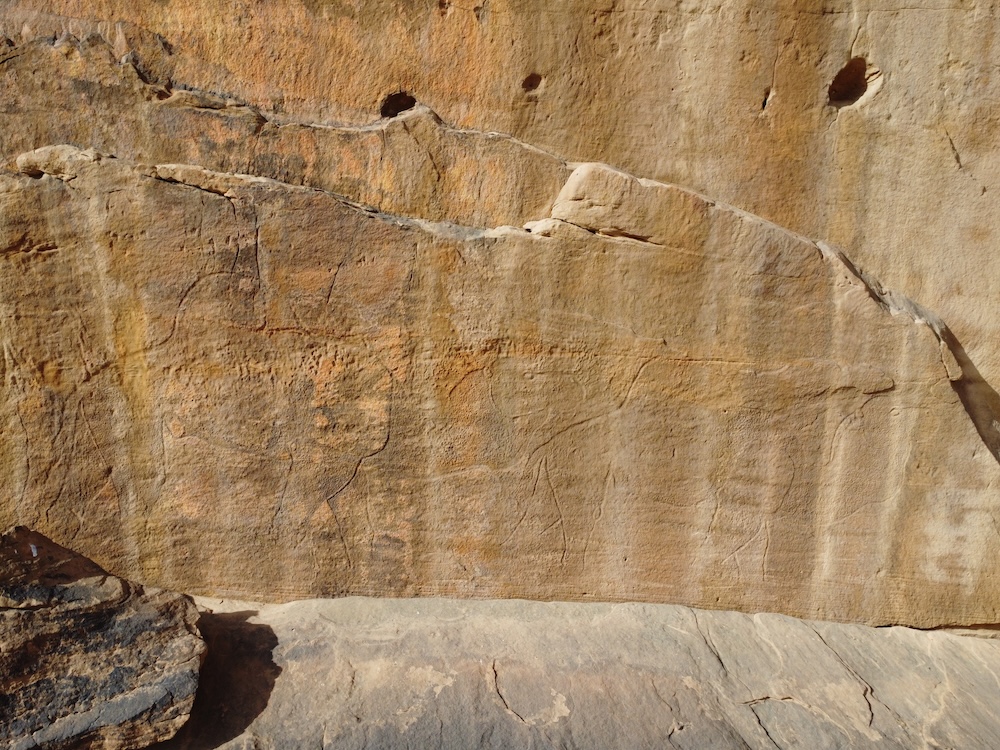
Credit: Sahout Rock Art and Archaeology Project.
The archaeologists also recovered stone tools from the same sites in their excavations. Some of the tools may have been the very ones used to make the carved animal scenes.
“These monumental images were used to mark water sources and the routes between them, perhaps providing impressive visual reminders of access rights, while also commemorating these extraordinary desert-adapted groups over millennia,” the study argues.
More discoveries to be had
In total, researchers at the site found more than 60 individual panels of rock art depicting 176 animals, mostly camels. Some were found carved into the faces of cliffs high above the ground.
The research team is convinced that these rock art examples represent more than the creativity and artistic talent of Arabia’s earliest human settlers.
As in the case of ancient cave paintings in France and Indonesia, the artists responsible for Saudi Arabia’s ancient rock carvings were expressing themselves and communicating important information at the same time.
There are almost certainly more such discoveries in store, hidden treasures buried in the sand that speak to human origins and the origins of art.
“These large engravings are not just rock art,” said lead author Dr Maria Guagnin of the Max Planck Institute of Geoanthropology. “They were probably statements of presence, access, and cultural identity.”
Park Info
Park:
King Salman bin Abdulaziz Royal Reserve
Location:
Saudi Arabia
More information: https://www.nature.com/articles/s41467-025-63417-y