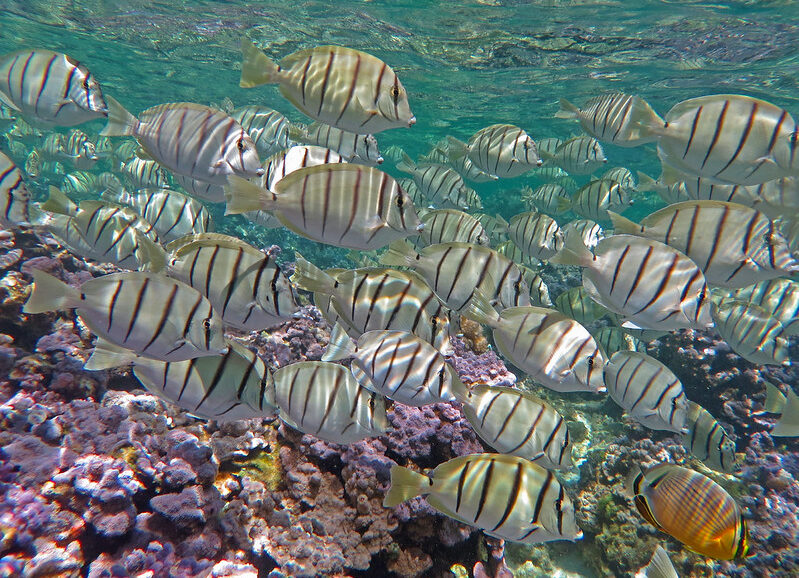
The network of marine protected areas (MPAs) the world has created throughout the years is just as vulnerable to global warming as unprotected ocean zones, an Australian scientist is now warning.
Though these MPAs are guarded from human impacts by various degrees, these protections may be rendered moot by 2040 as ocean temperatures rise. MPAs may need additional levels of protection and management methods to adapt, says Alice Pidd, a Ph.D. student and oceanography researcher at Australia’s University of the Sunshine Coast.
“Even with aggressive reductions in carbon emissions, by 2040,…Australia’s ocean conditions will cross a climate horizon,” Pidd told reporters in a recent briefing.
The “climate horizon” she refers to means conditions outside what’s presently considered normal. This involves changes not only in water temperatures, but also oxygen levels, water acidity, and impacts from periodic marine heat waves.
Global warming’s effects on the oceans as a whole hold “also true for areas within our existing marine protected areas,” she said. “Biodiversity in these areas are just as exposed to climate change.”
She said changing ocean conditions could render MPAs obsolete as “climate refugia,” or regions that can protect species from climate change, by 2040 “which is only 15 years away, which is quite alarming.”
New troubling research findings
Pidd and her colleagues reached these disturbing conclusions through a months-long investigation that fed publicly available data into new climate and ocean change modeling.
The outcome shows that additional global warming in line with what’s anticipated wil result in dramatic changes to ocean conditions, changes that MPAs will not be immune from. Pidd et al. findings have been made public in the journal Earth’s Future, published by the American Geophysical Union.
“MPAs are no better off than unprotected areas, facing the same risks from warming, acidification, deoxygenation, and marine heat waves as unprotected waters,” the authors concluded.
Efforts to reduce greenhouse gas emissions and mitigate against climate change could help, but not for decades, they warn.
“We found that reducing emissions could facilitate the reappearance of some climate refugia after 2060, but continuing along current emissions trends risks ecosystem collapse from warming throughout Australia’s protected and unprotected waters.”
More MPAs, better management
Pidd argues that these findings suggests that the world should rethink MPAs and how they are managed. Australia is often praised for the volume of ocean area it protects under MPA regimes. Pidd told journalists that their findings suggests MPAs located in Australia’s southern and southwestern waters fare the best chances of withstanding some of global warming’s onslaught. Elsewhere, different management approaches may be required.
The observation suggests that MPAs existing farthest from the equator stand the best chance over the long run. Tropical MPAs could face the greatest risk of ecosystem collapse.
“They may be fit for purpose now, but this is unlikely to hold for very long,” she said. “Marine biodiversity will be forced to adapt to this new normal.”
She stressed, however, that this is not an argument against MPAs.
The world has pledged to put at least 30% of marine areas under some form for MPA protection by 2030. Many countries are moving toward this goal. Only the United States is seriously backsliding, with the new White House administration determined to unwind protections on public lands and waterways.
Even if her research shows that Australia’s marine climate refugia will be cut in half by 2040 with or without the world meeting the climate mitigation goals of the Paris Agreement, Pidd said her country and others should consider expanding their MPA networks.
In terms of where they should be located and how they should be managed, “a multipronged approach is probably more the way forward,” Pidd said. She said special consideration should be given toward how immobile marine species like corals, sea grasses, and kelp forests are managed and protected in MPAs.
Take global warming seriously
When asked what individuals could do to help make the situation a little better, Pidd argued that voters’ choices mattered greatly. Through the ballot box, voters can signal to politicians what they expect their leaders to do about climate change.
“The [Australian] government is making some moves in these areas with its sustainable ocean plan,” she noted.
At the same media briefing, co-author Professor David Schoeman, an expert on global change ecology at the University of the Sunshine Coast, took this discussion a step further.
“We need our leaders to take climate change seriously, and leaders at every level,” Schoeman said.
“We’re in this situation we’re in now because we haven’t been taking climate change seriously,” he added. “We like to talk about it. We don’t like to do anything about it.”